


DAB is a system of adding several radio channels onto one transmitter. The signal is divided out among multiple stations. Its very efficient of spectrum, i.e. you can cram in far more signals onto one single frequency, albeit at the expense of poorer audio quality.

DAB & DAB+ stations
Copyright (c) 2012 - 2023 World of Radio Ltd,
Registered in England and Wales # 8503418.
All Rights Reserved. Reproduction strictly prohibited.
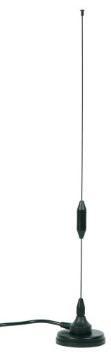
DAB signals are very high frequency, around 200 MHz and weaken very quickly. A good aerial is usually needed to pick up a robust signal. The higher this is placed the better, and the more reliable signal you will get.
It's important that a DAB receiver gets sufficient signal, which needs an external aerial. For a portable radio in a strong signal area a built in telescopic whip antenna may suffice, otherwise, its important to place an aerial as high as possible, and in the clear from building clutter.
This antenna's amplifier provides a lot of gain and will help you pull in a signal more strongly than you might otherwise expect. Click HERE for details.
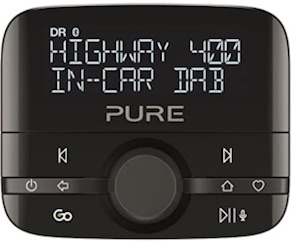
DAB+ in-car converter
This superb receiver can add DAB and the exciting new DAB+ format to any existing FM car radio. No need for a mess of wires either - the unit picks up the DAB signals and then rebroadcasts them (using a totally legal miniature FM transmitter). You then tune in your FM radio where you hear the DAB channel chosen. This unit will play the latest DAB+ stations, as well as the old fashioned DAB signals, and you retain use of the FM radio.
The PURE HIGHWAY
DAB+ in-car converter
costs £57 (approx)
A. Digital One Network
The original DAB service, which transmits programmes of the BBC National channels, the national INR service Classic fM, and some other commercial channels such as Heart, Capital, Magic, and Smooth. |
B Sound Digital
(Launched Feb 2016). Some stations have migrated from the original Digital One network plus a couple of new stations, and two reborn national services previously closed down (Virgin Radio and TalkRadio). Sound Digital can be heard across half of the UK. |


2. Regional
DAB Stations
The regional licences are for small areas usually covering a few hundred miles, the size of a county, which roughly corresponds to BBC local radio areas. These muxes carry the BBC and the regional commercial services run by the big groups, plus many 'filler" services of non stop music.
They have different names in different parts of the country. Some areas can hear two or even three local multiplexes, but in many areas listeners can hear none at all.


Brighton, |
Bristol, |
Manchester, |
London, |
Portsmouth, |
Aldershot, |
Norwich, |
Birmingham, |
Glasgow |
Cambridge. |
Each of the 'small scale' DAB muxes carried at least half a dozen stations, most used the superior DAB+ format. This enables better audio quality at lower bit rates, which in turn means more stations could be accomodated in the bandwidth available.
Most of Europe, Australasia and many other countries have adopted DAB+ for this reason. The experiment was a success and, in 2021, 25 new local MUXES will launch,each with up to 30- DAB+ stations heard on the air.
The DAB network will expand still further in the twenties, offering hundreds of new radio stations the chance to debut 'on the air'.
Full details can be found in the new book
DAB & DAB+
the Future of Radio ?

The big problem with DAB is that, because it is on a higher band of frequencies than FM, it doesn't travel so well. It's easily absorbed by buildings and the ground so many additional transmitters are needed, even in a small area.
To kick start the DAB system, the regulator gave only one licence for each area, and one national licence. A multiplex is called a mux and is a single transmitter that carries to many programme services. It was left up to the multiplex operator to licence programme suppliers, for provision of radio stations' or channels.
High Gain
DAB Antenna
Digital
One
National
Network
BBC
Radio
National
Network
There are three sizes of DAB mulitiplex:
1. National
2. Regional
3. Local (SSDAB)
1. National
Multiplexes
DAB radio needs
a decent antenna
for all the Latest News on
Digital Radio
[web / online / internet]
click this radio

3. Small Scale Trial DAB
The small Sacle DAB multiplexes authorised on a 'trial' basis were in ten or so towns and cities. After their success, OFCOM began rolling out several hundred multuplex areas in rounds of a couple of dozen areas at a time.

Aerials for DAB
Programme is simply supplied 'down the line' and the radio station usually has nothing to do with transmission, which all is done by the MUX operator.
The system became expensive with fees being kept confidential, well over £1 million pa.
In 2015 the UK regulator gave permission for ten experimental 'small scale' DAB multiplexes. These are now being rolled out in dozens of towns and cities to give a new tier of DAB stations.


The Digital Radio
Certification Mark
The Digital Radio Certification Mark (known now as the “tick mark”) identifies and gives greater assurance to consumers that the DAB digital radio products and services they are buying are future-ready and will enable them to receive the available DAB, DAB+ and FM radio stations. In order to be granted use of the tick mark, manufacturers must meet the minimum specification. In order for the manufacturer to prove that they meet the minimum specification, they must put their product(s) through testing.
This is because the first wave of DAB radios are now becoming obsolete as they won't upgrade, and are unable to receive the DAB+ stations, which use less bandwidth and offer far superior quality to the first wave of DAB.


More information on DAB
The UK's leading seller of tech kit, EBuyer, have an excellent article explaining more about DAB, and whether it might become THE standard for radio receivers. Their article and website also have some amazing bargains on the latest equipment. Well worth a look.


Click
SIMcard
for details
Mobile SIM offers
FREE SMS texts
FREE CALLS
Huge Data deals
(Ideal for radio!)

DAB
multiplex
operators
There are several main operators (known as transmission providers') of DAB signals in the UK. They transmit 'multiplexes' of channels using single transmitters over a small area. They don't provide the DAB radio programmes, but act as 'gateways' or 'transmission providers'.
NATIONAL
The BBC operates a major national multiplex covering most parts of the UK (No one achieves 100% coverage, not even as wide as the FM networks, which are also not 100% complete. The BBC multiplex carries the major BBC services.
DIGITAL ONE is a private distributor covering a bit less than the BBC's multiplex. Its services are mainly commercial, mostly from the two main commercial radio operators - Global and Bauer.
REGIONAL
The various regional multiplexes are run by two privately owned consortia: MXR Digital and Switch Digital.
The MXR networks are owned by Global and Arqiva and carries mainly commercial programmes. Switch Digital is owned by Carphone Warehouse and the Wireless Gorup.
LOCAL
There are several local digital multiplexes serving smaller areas. Many are run by transmission provider Arqiva and others by CE Digital, the Digital Radio Group and Bauer.
There are now some independent 'stand alone' operators of 'small scale digotal multiplexes', usually serving even smaller areas. These operations are poised to expand rapidly in the 2020s.
Digital Radio UK is a conglomerate of multiplex operators and also helps run the Digital Action Steering group, whose aim is to persuade the UK population to buy digital radio and abandon analogue listening.

for the Latest News on
web / online / internet Radio
click this radio

Paul Rusling's latest book examines the history of radio and what led to the birth of DAB in 1980. The launch of stations by the BBC and the slow expansion, with commercial stations being lured in by the promise of licence extensions. This book explains the differences between DAB and DAB+ and how the DAB networks are being rapidly expanded in the 20-20s. Click the book cover for full details and to order.
Paul Rusling's latest book examines the history of radio and what led to the birth of DAB in 1980. The launch of stations by the BBC and the slow expansion, with commercial stations being lured in by the promise of licence extensions.
This book explains the differences between DAB and DAB+ and how the DAB networks are being rapidly expanded in the 20-20s. The book costs £12.95 and is the first to tell the story of DAB and expain its operation and how DAB+ is about to take it to new audiences. Click the book cover for full details and to order.

Click this radio to see a huge range of receivers


SS DAB Round One
Multiplex Applicants
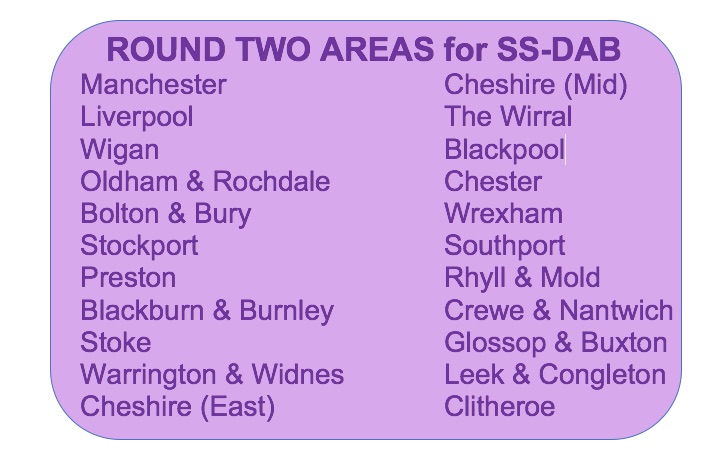
SS-DAB Round Two
Areas announced
The above are the areas known as 'Round 2' where OFCOM awarded multiplex licences in 2021, and which are now coming on air. The locations are mainly in Lancashire and those areas of North East Wales / Cheshire, etc.
Pure Highway 400
In-Car DAB+/DAB Adapter
with Bluetooth for Music Playback
SS DAB Round 3
Multiplex Areas
At the end of January 22, OFCOM invited applications to run DAB multiplexes in 25 further areas. Each Mux will have room for up to 30 DAB+ stations, and applications to run them had to be submitted by 25th April 2022. The areas are:


SS DAB Round 4
Multiplex Areas
OFCOM have now confirmed the 27 areas they are considering offering multiplex licenses for in late 2022. The ares are spread over the all four nations and are designe dto represent areas where there has been declarations of interest from prospective station operators.