Bowie hated copyright
David Bowie was always a firm advocate of copyright being abolished and was the first to release material on the internet only, in 1996.
The copyright rules have been implemented by the music business to limit radio stations playing any artist's music, as some believed this might stop people buying records. Stations cannot play any artist more than 4 times in a 3 hour period, and never more than 3 tracks in a row. For any particular album, the limit of 3 tracks in 3 hours, or two consective tracks, is imposed.
This reason is why many stations were unable to play a full day, or even an hour, of David Bowie tracks when he died in January 2016. Unless specific waivers are put in place between an artiste and each station using it, lengthy tributes are against the rules.


"I'm fully confident that copyright, for instance, will no longer exist in 10 years, and authorship and intellectual property is in for such a bashing.''
''Music itself is going to become like running water or electricity,'' he added. ''So just take advantage of these last few years because none of this is ever going to happen again. You'd better be prepared for doing a lot of touring because that's really the only unique situation that's going to be left. It's terribly exciting."
"But on the other hand it doesn't matter if you think it's exciting or not; it's what's going to happen.''
All David Bowie's releases can be downloaded NOW
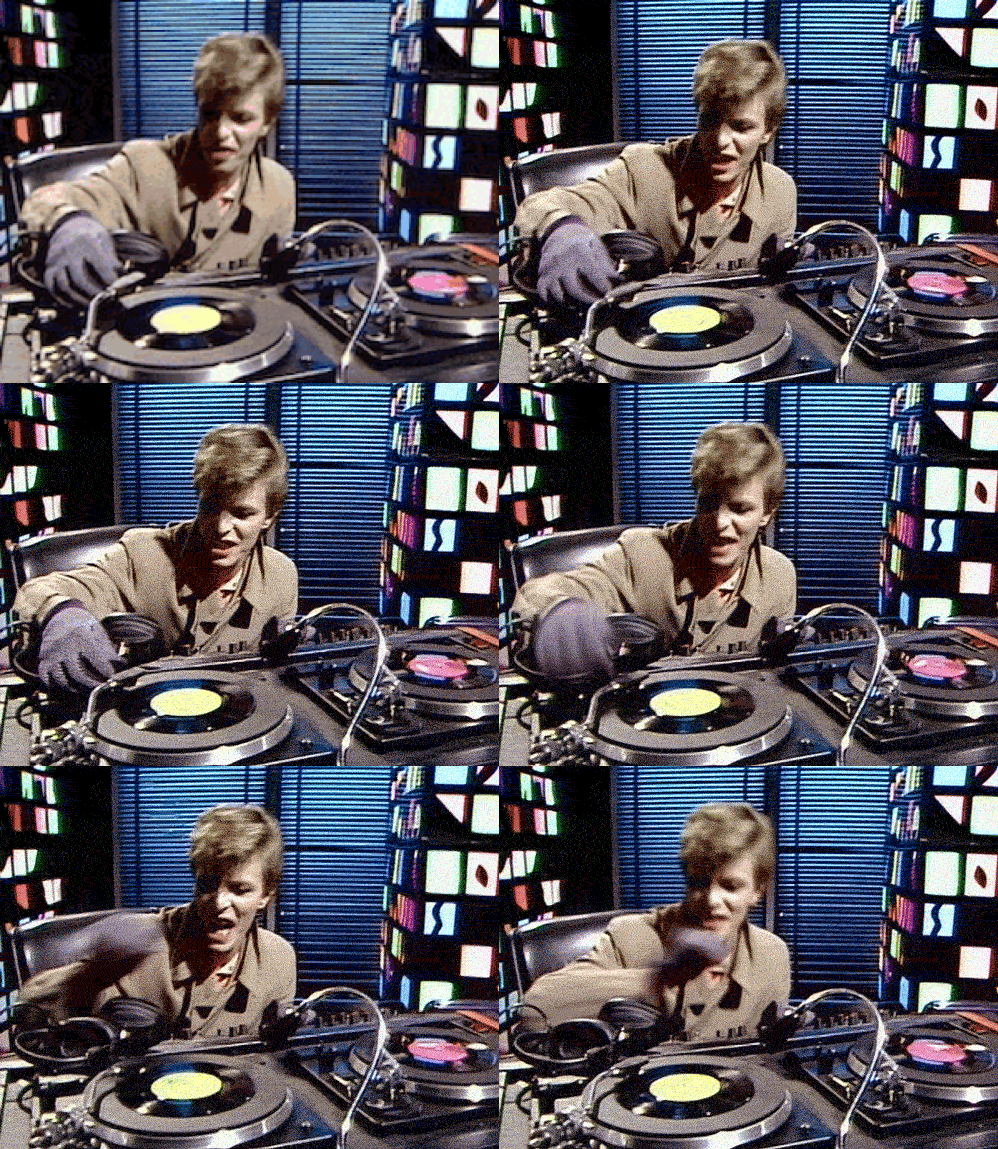
David Bowie DJ


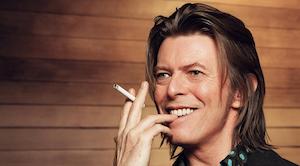
David Bowie's
'End of Copyright' interview
In 2002, David gave an interview to the New York Times in which he predicted the end of copyright altogether, as well as record labels, as they would no longer serve a useful purpose. David's deal with Sony Records was originally intended to be a short-term arrangement, pending him starting his own label.
''I don't even know why I would want to be on a label in a few years, because I don't think it's going to work by labels and by distribution systems in the same way,'' he said.
''The absolute transformation of everything that we ever thought about music will take place within 10 years, and nothing is going to be able to stop it. I see absolutely no point in pretending that it's not going to happen."
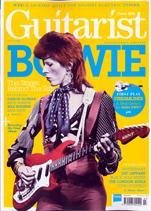
Bowie Bonds
In 1997, David Bowie went way beyond every other music business model experiment by issuing Bowie Bonds, creating a financial instrument that was backed by the royalties from his music, without losing control of the actual music itself. That same year, he also became the first major musician to "cybercast" a live concert online. Other musicians had tried similar things around that time, but Bowie was by far the most well-known (though the technology was very lacking).
Just a year later, in 1998, David Bowie launched BowieNet, his very own internet service provider (ISP), saying "If I was 19 again, I'd bypass music and go right to the internet." That was 1998, the year that Google was founded.
Hundred page paperback book, available immediately from Amazon.


The story of how radio formats developed in the UK and the US. This new book tells how rigid regulation held up radio in Europe while stations in the US mushroomed and grew, to be worth many times those in the UK, pro-rata to population.Over 130 formats are described in the 100 page book which will be of interest to avid listeners, students and radio professionals alike.
Fascinating new radio book

only £26.38
incl VAT
Copyright (c) 2004 - 2023
World of Radio Ltd,
Registered in England and Wales # 8503418.
Reproduction strictly prohibited.
All Rights Reserved.
Rock'n'Roll revolutionary
By 2000, he was already talking about just how revolutionary the internet was going to be for music: "I got into music because it was a rebellious thing to do.It had a sort of 'call to arms' feeling to it. This is the thing that will change things. The internet carries the flag of being subversive, possibly rebellious as well as chaotic and nihilistic. Forget about the Microsoft element. The monopolies do not have a monopoly. I like the idea that there's a demystification process going on between the artist and the audience."
"We haven't even seen the tip of the iceberg yet. I think what the internet is going to do to society, both good and bad, is unimaginable. I think we're on the cusp of something exhilarating and terrifying."
"The actual context and the state of content is going to be so different to anything we can envisage at the moment. The interplay between the user and the provider will be so in simpatico it's going to crush our ideas of what media is all about."
Artists like Duchamp were so prescient here - the idea that the piece of work is not finished until the audience comes to it and adds their own interpretation, and what the piece of art is about is the grey space in the middle. That grey space in the middle is what the 21st century is going to be all about."
Updated edition
now available