

High Power
'Border Blasters'
By the 1930s it became possible for radio stations to cover much greater distances thanks to newer high power transmitters. The American FCC put a cap on the power levels of stations, which encouraged local broadcasting, with a few large networks developing, such as NBC, CBS, Mutual, etc.
Those limits of power output did not apply over the border in Mexico and several entrepreneurs set up very powerful stations, with power levels up to 250,000 watts, five times what was permitted in the USA. These cross-border stations did good business running commercials for products that were banned from the airwaves in the USA, including several medical services of dubious efficacy, such as goat gland transplants for 'gentlemen of diminishing libido'.
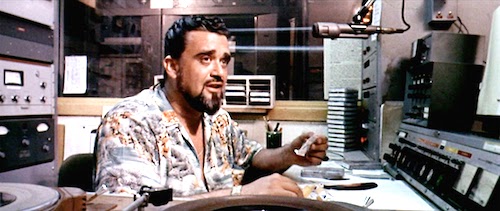
Some stations thrived for decades, especially those in in the west of Mexico near Tijuana that had massive signals across into California and right up the west coast. Others further east such as XERA were just a few miles from the border with Texas and enjoyed large audiences across the eastern seaboard. After dark, the nature of Medium Waves meant that such stations were heard all over the USA. In the 50s and 60s, some stations acquired legendary status, with Wolfman Jack becoming so famous.

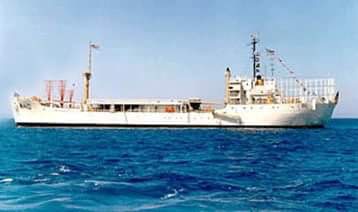
The first widely heard European offshore station - the MV Courier (a US Coastguard vessel) which broadcast the Voice of America from the Mediterranean into Russia.
After World War II, the NATO countries wanted to spread the word of freedom behind the Iron Curtain that had descended across Europe. Much had been learned in the war years about the value of propaganda, especially by radio. Once the Cold War began in the early 1950s, the three main powers stepped up their international transmissions accordingly.
Some of the western broadcasters, such as the BBC World Service and the USA's Voice of America, could not be clearly heard in many parts of the USSR, so the American coastguard took a leaf from the mobsters' book and fitted out a ship called The Courier to beam its radio programmes into Russia. The best location for the ship was found to be at the eastern end of the Mediterranean Sea, from where the MV Courier beamed in its diet of news and comment.
The VoA ship had very powerful medium wave and short wave transmitters on board, over 150,000 watts, very high power levels for that period. Most of the programmes were originated at studios in the USA and sent to the Courier by short wave radio. Technicians on the ship recorded them and then rebroadcast them on the on board MW and SW transmitters.
Several antennas were installed on the ship, including a novel long wire antenna held up by a helium balloon floating several hundred feet above the deck. This was an excellent way to get the most efficient (electrically) aerial on a ship out at sea. The reason for this is that a medium wave antenna needs to be very long if it is to operate with reasonable efficiency. The operation was a great success and only stopped broadcasting when the Greek Government gave her a permanent base in Rhodes.

Ever wanted your own
ONLINE RADIO STATION?


This fascinating book gives you full details of all you need to know: how to assemble everything, how much should you pay and how to launch. Where do you get the bandwidth to broadcast, which system should you use and how do you promote your station?
To get this information on a seminar or course would cost about $1,500. Download it today, onto your computer, tablet or any iPhone and read all 77,000 words straight away.

Only $9.99 / £6.68
This fascinating book gives you full details of all you need to know:
how to assemble everything, how much should you pay and how to launch. Where do you get the bandwidth to broadcast, which system should you use and how do you promote your station?
To get this information on a seminar or course would cost about $1,500. Download it today, onto your computer, tablet or any iPhone and read all 77,000 words straight away. Or buy the printed vfersion and have all the details ready to hand on your bookshelf. Immediate despatch from Amazon.

also available
in printed form
(a real book ! )
Ideal for your any
radio afficionado's shelf
Just £19.95 FREE P&P

American super Border Blaster
of the 50s and 60s
Border Blasters


More books about the World of Radio
There are thousands of books about radio and we have reviewed some of those books that we believe may be of interest to you. There are currently over 300 radio books in our library which we shall review over the next few weeks, so do visit our BOOKS section often.
The famous old XERA radio towers just outside Villa Acuña, just over the border from Del Rio, Texas. XERA was a “border blaster”, a radio station that had a 250,000 watt transmitter and it broadcast country, soul, R & B, and everything else across the border and into the United States from the 1930s until the late 1960s.
XERA could be heard from coast to coast, from Los Angeles to New York, and well north into Canada too. At times it could be heard in Europe too.
The border blasters pioneered "info-mercials" and originally sold mail order goods, such as Dr. Brinkley’s goat-gland operations in Del Rio TX. Many of the border blaster stations played country music, as their target audience was mainly in the wide open mid west of the USA, where country music went down very well.
Singers such as Patsy Montana and the Carter Family saw their careers get a 'new life' on XERA. Later some stations majored on playing black music; lots of RnB, and best remembered DJ from that era is Wolfman Jack. “Heard on the X” is a song recordfed by ZZ Top in the 80s, remembering the border blaster stations of their youth.


XERA Mexico,
(later called XER)
Hear Wolfman Jack on
Mexican 'Border Blasters'
This video player lets you hear what Wolfman Jack sounded like on the best known border-blaster radio
Legendary DJ Wolfman Jack was heard on several stations in Mexico, including the giant XERF station whose massive 250,000 watt signal could be heard right across North America after dark.
Wolfman Jack's growling and exuberant style was exciting to kids seeking something different; it was rebellious and somehow just a little bit 'naughty'. He adopted mannerisms and phrases used by black artists and for some years he kept his ethnicity secret, believing that by sounding as if he might be black would attract more of the young white kids, which is just what the advertisers wanted.
Wolf knew exactly what the kids wanted to hear and talked up his own mysterious persona on the air, giving an illusion that the border blaster stations were somehow not at quite mainstream and 'your parents wouldn't approve'. That was a huge part of the appeal of such stations to young American kids from the late 1950s until the late 1970s.
By then Wolf had moved to syndicating his shows over a hundred stations all over the world, from Los Angeles. He also became a well known TV star but always kept that cloak of being somehow just on the wrong side of respectable, which he recognised was the main draw to his youthful audience, many of whom were now the 'Baby Boomer' generation.
Heard it On The X
ZZ TOP
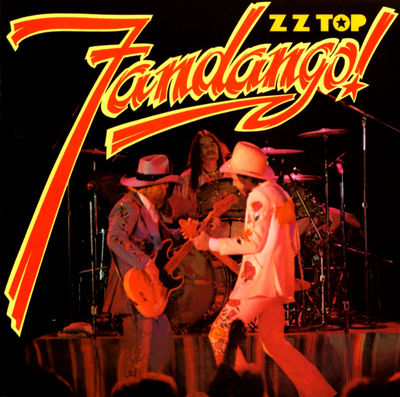
This is a song written and by ZZ TOP in the 1970s, and later released on their Fandango album. It has become one of the band's most requested numbers when they play around Texas, being such an emotive song for those who grew up in Dallas, Austin and Houston. It is about the Mexican Border Blaster stations, as the lyric shows:
We can all thank Doctor B
Who stepped across the line.
With lots of watts he took control,
The first one of its kind.
So listen to your radio
Most each and every night
(Copyright 1975,
With thanks to Frank Beard,
Dusty Hill and Billy Gibbons)
Click the sleeve to hear it,
or download
This is a song written and by ZZ TOP in the 1970s, and later released on their Fandango album. It has become one of the band's most requested numbers when they play around Texas, being such an emotive song for those who grew up in Dallas, Austin and Houston. It is about the Mexican Border Blaster stations, as the lyric shows:
We can all thank Doctor B
Who stepped across the line.
With lots of watts he took control,
The first one of its kind.
So listen to your radio
Most each and every night
(Copyright 1975,
With thanks to Frank Beard, Dusty Hill and Billy Gibbons)
Click the sleeve to hear it,
or download


CKLW is a 50,000-watt, Class B, AM radio station that broadcasts on the Mexican clear-channel frequency of 800 kHz (800 AM).The transmitter is located in Windsor, Ontario, and so is a Canadian radio station.
It began broadfcasting in the early 1930s and moved to 800 during WW11. Its been there ever since. The CKLW signal covers the Detroit metroplitan area and it has long enjoyed good reception over much of the mid USA, whch is has exploited by programming for the American audience, rather than Canadian. For many years CKLW was the MUTUAL BROADCASTING SYSTEM's affiliate in the Detroit area.
CKLW uses a five-tower directional antenna with different coverage patterns day and night, to protect XEROK-AM in Ciudad Juárez, Mexico.
CKLW was an internationally known Top 40 station in the 1960s and 1970s. During this era, CKLW used a tight Top 40 format known as Boss Radio, devised by radio programmer Bill Drake. However, CKLW never actually used the handle "boss" on the air, just the style.
Rather than a "Boss 30", CKLW's weekly music survey was known as a "Big 30". CKLW called itself "The Big 8" referring to its dial position. During this period it was the top-rated radio station not only in Windsor, but across the river in Detroit, and even in cities as far away as Toledo and Cleveland in Ohio.
CKLW is now known as "The Information Station" and is mainly talk formatted; it is owned by Bell Broadcasting.


'Lucky' Radio Luxembourg
This three tower system was used to transmit programmes of Radio Luxe,bourg from the Grand Duchy from 1934 until last year. Thne station broiadcast at high power (2 million watts Long Wave and 1.2 million watts Medium Wave) to neighbouring countries. The station was funded by commercials and music plugging.
Get INTERNET RADIO
as a Kindle / e-book
Only $9.99
Only $9.99
or £6.68

Also available as a Softback
276 page book - £19.95

Full details telling you what you need, how to assemble everything, how much should you pay and how to launch. Where do you get the bandwidth to broadcast, which system should you use and how do you promote your station?
To get this information on a seminar or course would cost about $1,500. Download it today, onto your computer, tablet or any iPhone and read all 77,000 words straight away.


RADIO FORMATS
in the UK & US
a great new book describing the evolution of radiointo tightly formatted stations, using scientifically researched audience demographics. The book descibes over 130 formats used by radio stations in the UK and USA -
for more details CLICK THE COVER
Copyright (c) 2011 - 2023 World of Radio Ltd,
Registered in England and Wales # 8503418.
All Rights Reserved. Reproduction strictly prohibited.