


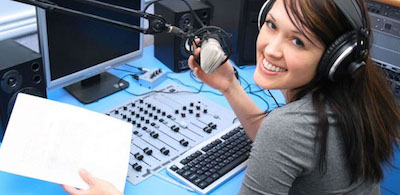
The heart of a radio station, for presenters, is the mixing desk, often shortened to simply “the mixer”. It is also variously called a console or a board in places. It controls the various programme sources and adds their audio together before sending them to the radio station's real heart, the racks.
Mixers are generally problem free until a presenter decides to feed them with a drink or other substances. Rotary faders were most 'presenter proof' as there was little room for the tea, coffee or coke to get in, and being mounted almost vertically there was less chance of a heavy pile of vinyl or anything else being dropped on them.
Since horizontal / linear faders became common-place in the 1970s, the mixing desk has become much more vulnerable. Some studios introduced a firm 'no liquids' ban but the desk is still the most vulnerable item of equipment in a studio.
Digital Mixing Console
The move to digital mixing, where the desk is simply controlling a remote piece of audio equipment in a racks room elsewhere, is a tremendous boost to reliability.
At its simplest a mixing desk is just a set of controls that will mix together the outputs of your sound sources. The complexity of the mixing console needed will depend on the type of programme you intend having, in particular how many sources will you use, and how much control will the operator have over the playout process.
The mixing desks seen in recording studios will often have many channels into which the sources can be fed. 64 and 128 channels is becoming standard, and each of those channels can have up to a dozen separate controls with which to set various equalisation parameters, sending to effects such as reverb' and so on. A recording studio desk however is neither necessary nor indeed optimum for radio broadcast use. The main need in a radio studio is for 'controllability'.
Controllability
The mixer is the heart of a radio station and as such is not simply a tool for varying the sound levels or EQ. It should also be the place where all the various programme sources are controlled; switching sources in an out of circuits, remote starting items and so on. Sources need to be 'auditioned' or cued up ready for airing, some need to be sent to external processors, or to be recorded. The needs of radio station mixer are many and various and quite unique.
At the very least, a radio mixing desk needs to have a method of cueing, or auditioning a source, without putting it into the programme chain (live on the air). Cue circuits (usually a separate channel) enable the precise start point of the source's programme material to be found, and then handed to a remote start control on the desk. This is often included into the main fader, so that when it is activated it automatically cues the item for 'instant start'. This is regarded as 'slick presentation' - a seamless playout without embarrassing gaps between items.
Touch Screen Console
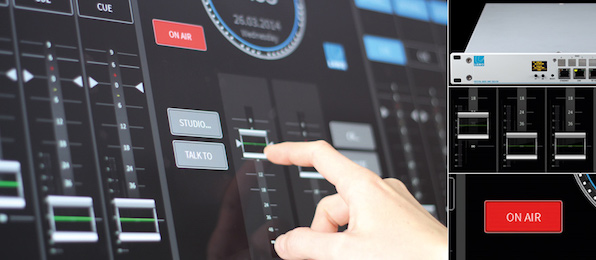
The most 'up to date' mixing consoles are touch screen. A high-resolution monitor has its entire surface given over to the controls of a virtual radio studio, with the couple of dozen controls needed to run a radio programme being presented in whatever size is convenient.
All but the most important controls can be hidden at whim, with items such as EQ and SFX which are not in constant use. Every control can be operated simultaneously, depending on the dexterity of the operator and there is no audio at the screen, everything stays safe in the racks area.
The Lawo crystalClear console (seen below) is faster and easier to use than conventional boards and has a variety of advantages, all set out on Lawo's web site. Unencumbered by physical knobs, switches and faders, presenters are less intimidated and can focus more easily on their programme's content. Just touch one a few times and you will be convinced!
A good overview of the LAWO range can be found in their downloadable brochure.
Axia Audio are the studio and audio part of the Telos Alliance. In 2003 they invented 'audio over IP' for broadcasting developing broadcast audio equipment for tranmission over standard Ethernet. The mainstay of their technology is Livewire +, a patented AoIP protocol. Its part of the AES67 standard that's used by virtually all players in the 'Audio over IP' industry. By using everyday Ethernet cable and connectors, the cost and reliability of AoIP have been transformed.
Fusion is Axia's new modular console and it has heaps of features; Clark Novak is the best person to run through all its attributes and he can be seen on this video doing just that.
Axia's Element console is popular around the world; there are now over 5,500 of them out there as the main workhorses in thousands of radio and TV stations. It not only has four stereo buses, but it also features digital EQ, dynamic mic processing and such initiatives as virtual faders which let you run five channels at the same time over a single fader.
D&R
A well known Dutch company formed by Duco de Rijk and Ronnie Goene in the early 1970s. Duco had a number one hit in Holland with his band's superb version of the lead song in the show 'Hair', thanks to lots of airplay on Radio Veronica. D&R have also built desks for many well known Dutch music artists for stage use and for Radio Luxembourg too.
D&R's equipment is still commented on today with its unmatched 'headroom' giving superb sound. Their mixers have a tremendous fan base, due to the quality of the electronics and the structure. D&R still supply spares for many of their products going back forty years.
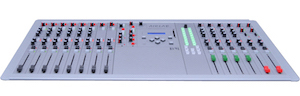
The main models of interest to radio stations are the Airlite, the Airmate (seen at the top of this page, the Airence and the top of the range,The AIrlab. All are available in the UK from local agents Broadcast Warehouse, the full specifications and pricing information of the full D&R range of superb consoles can be found by clicking the Airlab, below.
Arrakis Systems are an American manufacturer of mixing consoles with a wide range of capabilities. Included in their repertoire are desks designed with Internet Radio stations in mind and a special internet streaming service made simple.
The ARC-8 radio console is an eight channel single output mixer that's compact and durable. It's made for professional radio applications using a strong steel chassis. It has linear faders, switches with LED lit indicators and it has a Bluetooth input so you can feed in audio from either a phone or a tablet. There is a phone channel with mix minus, and a Talkback button so you can speak to callers off the air.
The ARC-8 has two high performance mic channels and a USB channel to connect to a PC or a Mac for playback or record. This console will do everything you need to run a radio programme and it costs around $850. You can see the ARC8 demonstrated here or read the full specifications.
Bespoke
studio
desking
SONIFEX
A well known British brand of mixers, and many other studio toys, Sonifex have three main consoles for the radio studio:
The basic basic mixing desk, is the Sonifex S0, a high quality but easy to operate unit. It's very suitable for Internet Radio stations and even includes a telephone hybrid for taking and receiving calls from guests or listeners live on the air. It has sockets for plugging in MP3 players and even a USB connection for interfacing with an automation system via a computer.
The mixer can be rack mounted or set flush into a desk. Full details of the S0 specs are can be found by clicking the machine (above).
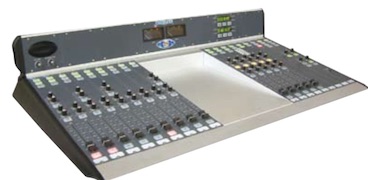
The Sonifex S2 is a modular mixer coupling digital audio quality with analogue reliability. It can accept both digital and analogue inputs, with simultaneous analogue and digital outputs. The S2 has PFL/cue, fader-start operation of sources, automatic muting of monitor speakers on mic going live, controls for 'studio live' lights, EQ on input modules, gram amp input options and twin audio buses. You can see the full specs of the Sonifex S2 by clicking on the picture.
Mixing
Consoles
D&R Airmate
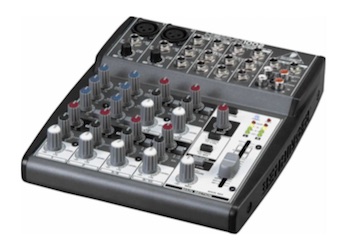
Both Behringer and Soundlab produce a wide range of small mixers that are designed for use by vocalists and musicians, but which are available cheaply and could be pressed into use as radio station mixers.
The latest prices can be seen by clicking the small mixer below. They will handle the audio and equalise it well, although some DJs find the controls small and fiddly.
Sonifex S2
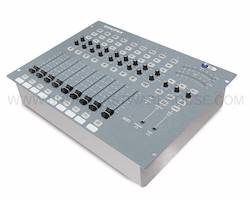
Sonifex S0
Mixing consoles
via
Internet



The headphone feeds on this mixer have limiters
included and the main
microphone control
also mutes the
speaker monitor
section.
There is a large LED
display for monitoring levels
and both programme and
record outputs.
Copyright (c) 2011 - 2023
World of Radio Ltd
Registered in England and Wales # 8503418.
Reproduction strictly prohibited.
All Rights Reserved.


RODECasterPro only £555
the latest Remote radio studio mixer
with 8 built-in assignable SFX buttons
click mixer for details
The heart of a radio station, for presenters, is the mixing desk, often shortened to simply “the mixer”. It is also variously called a console or a board in places. It controls the various programme sources and adds their audio together before sending them to the radio station's real heart, the racks.
Mixers are generally problem free until a presenter decides to feed them with a drink or other substances. Rotary faders were most 'presenter proof' as there was little room for the tea, coffee or coke to get in, and being mounted almost vertically there was less chance of a heavy pile of vinyl or anything else being dropped on them.
Since horizontal / linear faders became common-place in the 1970s, the mixing desk has become much more vulnerable. Some studios introduced a firm 'no liquids' ban but the desk is still the most vulnerable item of equipment in a studio.
Digital Mixing Console
The move to digital mixing, where the desk is simply controlling a remote piece of audio equipment in a racks room elsewhere, is a tremendous boost to reliability.
At its simplest a mixing desk is just a set of controls that will mix together the outputs of your sound sources. The complexity of the mixing console needed will depend on the type of programme you intend having, in particular how many sources will you use, and how much control will the operator have over the playout process.
The mixing desks seen in recording studios will often have many channels into which the sources can be fed. 64 and 128 channels is becoming standard, and each of those channels can have up to a dozen separate controls with which to set various equalisation parameters, sending to effects such as reverb' and so on. A recording studio desk however is neither necessary nor indeed optimum for radio broadcast use. The main need in a radio studio is for 'controllability'.
Controllability
The mixer is the heart of a radio station and as such is not simply a tool for varying the sound levels or EQ. It should also be the place where all the various programme sources are controlled; switching sources in an out of circuits, remote starting items and so on. Sources need to be 'auditioned' or cued up ready for airing, some need to be sent to external processors, or to be recorded. The needs of radio station mixer are many and various and quite unique.
At the very least, a radio mixing desk needs to have a method of cueing, or auditioning a source, without putting it into the programme chain (live on the air). Cue circuits (usually a separate channel) enable the precise start point of the source's programme material to be found, and then handed to a remote start control on the desk. This is often included into the main fader, so that when it is activated it automatically cues the item for 'instant start'. This is regarded as 'slick presentation' - a seamless playout without embarrassing gaps between items.
MIXER - aka Console / Board / Desk
SONIFEX
A well known British brand of mixers, and many other studio toys, Sonifex have three main consoles for the radio studio:
The basic basic mixing desk, is the Sonifex S0, a high quality but easy to operate unit. It's very suitable for Internet Radio stations and even includes a telephone hybrid for taking and receiving calls from guests or listeners live on the air. It has sockets for plugging in MP3 players and even a USB connection for interfacing with an automation system via a computer.
The mixer can be rack mounted or set flush into a desk. Full details of the S0 specs are can be found by clicking the machine (above).
The Sonifex S2 is a modular mixer coupling digital audio quality with analogue reliability. It can accept both digital and analogue inputs, with simultaneous analogue and digital outputs. The S2 has PFL/cue, fader-start operation of sources, automatic muting of monitor speakers on mic going live, controls for 'studio live' lights, EQ on input modules, gram amp input options and twin audio buses. You can see the full specs of the Sonifex S2 by clicking on the picture.