Apogee Electronics Trak2
Apogee make superb electronic equipment including microphones and musician-focussed accessories, including the lovely Trak 2 twin channel; mic amplifier. Gear4Music are the best UK distributor we know of who stock their equipment.
Toolvox OMNIA
Very long established piece of kit from the TELOS ALLIANCE people. We have found great difficulty in obtaining supplies of this processor and will advise if it ever becomes available.
IDT Virtula Voice Processor
IDT are a well known French company making processors for AM, FM and TV. Many of their processors are found at stations in Frncophone countries. They won one of the 'cool stuff' awards at NAB2000 (and bought me lunch!) but we are unable to recommend them as they are difficult to find.
Crane Song Flamingo
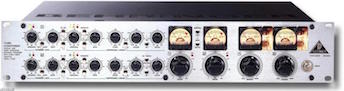
A superb Stereo/ Dual Mono Class-A Microphone Pre-Amp, which is capable of being operated as a musically transparent amplifier. A great sounding piece of kit, audibly transparent. Thomann is capable of emulating vintage sounds as well as creating distinctive new ones.
The Flamingo uses 'no transformer' balanced XLR inputs and outputs, 48V Phantom Power, Phase Switch and 22 Element VU Metering, Selectable Tonal Coloration too. Are you spending $3,000 on your station sound for just a pre-amp? That's rather more than the best microphone costs!

The main types of processor encountered in the radio broadcast chain are:
Microphone Processor
Transmission Processor
Both are audio processors and the principles are similar; to alter the sound in ways that improve its reception or intelligibility.
The basic processing that audio signals undergo is of gain, the change the volume level, and equalisation - adding or reducing the bass, mid or treble frequencies. Contolling the LEVEL of gain is vital for several reasons, not the least of which is to make listening a more pleasurable experience for listeners. Constantly varying the volume of a receiver is a nusance.
More importantly, allowing sudden and large variations in level can damage items of equipment later in the broadcast chain, including valves or semiconductoirs in the Power Output stages.
The two parts of the audible spectrum, bass and treble, which are often seen on domestic equipment and as 'mid range, often seen in musicians PA equipment, are in fact very much 'generalisations'. For professional audio processing, it's preferable to split the audible spectrum into several bands, perhaps as many as ten. Audio processing tweaks and modifications are then applied to each part of the spectrum individually.
As well as equalisation, a signal may be expanded, in which the volume is increased during quiet periods, or limited, which adds a ceiling to the highest sounds and stops them going beyond a certain threshold. A signal may also be companded, which is to supress the high sounds and squeeze in all the minima and maxima, effectively squashing the sound.
The amount of processing added to a signal may make it very dense, so it sounds LOUD to the human ear. Adding too much processing however while making the sound 'loud and proud' on a radio dial in fact also makes the ear get very tired of hearing it after a while. this is called 'listener fatigue' and often makes people switch off a radio station.
A commonly seen but very misundestood control on any audio processing is GATING. This is simply some circuitry muting the audio signal when it is below a certain threshold, making the signal quieter as it reduces 'background' noise. The 'noise floor' is the general mush and low level sounds that do not add any information to the audio.

Omnia AX/E
Streaming Audio Processor
OMNIA 9 PROCESSOR
- Integrated de-esser with switchable male/female voice recognition
- Switchable tube simulation for the extra warmth and transparency
- Automatically or manually adjustable attack and release times
- Stereo couple function with independent output level settings
- GC (interactive gain control) peak limiting circuitry combines clipper and programme limiter for reliable inaudible protection against signal peaks
Behringer Composer
Behringer FBQ1502 Ultragraph Pro 15 Band
Stereo Graphic Equalizer
This is a fifteen band graphic equaliser which allows you to really get down to noises and isolate them out of an audio chain. or if you wish you can enhance them. Gives excellent control over audio equalisation.

The FBQ 1502's revolutionary FBQ Feedback Detection System can also be used as Audio Analyzer and a dedicated mono subwoofer output with adjustable crossover frequency. It has additional low cut filter which acts lmolst like a notch filter that removes unwanted frequencies, e.g. floor rumble or other extraneous noises. Its highly accurate four digit LEDs meter the output and give input gain control for easy level setting. This equaliser has ultra low-noise operational amplifiers which offer outstanding sound performance. The balanbced inputs and outputs have quarter inch jack and gold-plated XLR connectors. It has a well shielded toroidal power transformer inside which gives ultra low-noise performance. A super addition to any studio rack - and only £189 from Amazon.
Copyright (c) 2011 - 2023 World of Radio Ltd,
Registered in England and Wales # 8503418.
All Rights Reserved. Reproduction strictly prohibited.
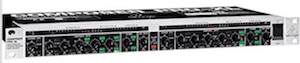
Behringer VC2496
The Behringer VX2496 is based on the well-known predecessor the VX2000 and provides 24-bit/96kHz performance. It features an AES-3 output and features an opto compressor, dynamic enhancer, expander, de-esser and tube simulation.
The output sampling rate on the VX2496 is adjustable and can be tied to a clock reference. There is a ultra low-noise mic/line input stage with soft mute, 48vdc phantom power. The tube emulation circuitry provides tube and tape saturation sounds, and the true RMS expander offers smooth noise reduction. An opto compressor provides dynamic control and creative signal processing options.Voice-optimized equalizer.
Also available in Behringer's range are these models: Ultragain Mic 100, Ultragain Mic 200, Ultragain Pro Mic 2200 which we have tried and all are more than capable of enhancing mics for radio use. A valuable addition to any studio's rack.
Other Audio Processors
and Mic Pre-Amps
worth a look & a listen!

When you need to remove distortion while selectively undoing the over-compression so common in mastering today, look no further than Omnia 9/XE
The 9/XE optimizes sound quality of low bit rates by literally removing distortion components so that they do not waste bits during encode
6-BAND PARAMETRIC EQ
FOR YOUR SIGNATURE SOUND
Sonifex PreAmps and Limiters
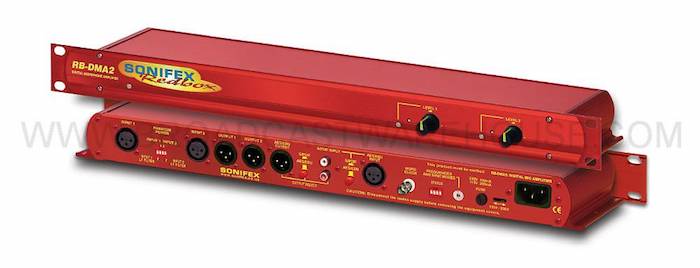
Not really a special effect but a professional quality dual digital microphone pre-amplifier. It has two independent, low-noise mic pre-amplifiers with studio standard AES-3 and S/PDIF digital outputs as well as analog outputs. The unit can be used as two independent mic amps or one mic input can be copied to both channels of the digital output. Inputs are electronically balanced.
The input gain for each input is adjusted on the front panel. Each channel has a selectable high-pass filter and 48V phantom power. A TTL word clock sync input is also provided. The EIN is 130dB. A tri-color LED indicates the audio level. These are available from Broadcast Warehouse for either £225 for the single mic preamp (MA1) or £525 for the dual digital mic amplifier.
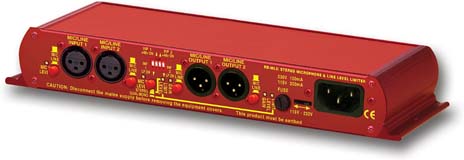
Sonifex's RB-ML2 is a combined stereo microphone and line level limiter. The unit is mainly used where assistance with level control is required, for protection of mixer inputs and to prevent distortion. It's idel for small studios and for news-booths. Also useful for controlling the input to PC workstations.
The RB-ML2 has two electronically balanced XLR-3 inputs, which are routed to a line amplifier, or microphone amplifier, via a rear push-button. The microphone amplifiers have independent pre-set gain controls, and DIP switches for a high pass filter (low frequency roll-off at 125kHz) and phantom power to provide +48V to the connected microphones.
The outputs of these amplifiers are passed through a VCA limiter circuit that can operate jointly on the signals in stereo mode, or independently in dual mono mode. The rear panel mode switch changes the unit from dual mono to stereo. Stereo limiting operates by limiting both left and right outputs if either left or right input needs to be limited. Dual mono limiting operates by limiting left and right signals individually, so you can use the RB-ML2 as two separate mono mic/line limiters.
The two XLR-3 electronically balanced outputs can be set to either line or mic output levels via a push-button. This allows the RB-ML2 to be used with a mic input or line-in circuit on a mixer.
Click here for the Limiter
Sonifex Microphone Limiter

Z/IP ONE is a 1 RU rack-mount IP codec for remote broadcasting. It’s a single space rack unit that is purpose designed and is perfect for studios, TOCs and remote installations.
Z/IP ONE Includes a full range of codecs including AAC-ELD, AAC-HE, AAC-LD, MPEG 4 AAC, MPEG 2 AAC, MPEG Layer 2, G.711, G.722 codecs, plus linear audio and optional aptX® Enhanced coding. Z/IP ONE supports SIP 2.0 protocol and conforms to N/ACIP standards; The Telos Z/IP One also works with many other VoIP devices and can be used to connect to compatible SIP PBXs. It offers a choice of Livewire+ AoIP with standard analog I/O, or optional AES/EBU I/O, is available.
You can get full details of the Telos Z/IP ONE by clicking the graphic above.

Telos Z/IP ONE Broadcast Codec


Telos Z/IP Stream R/2
Following on the success of Z/IPStream R/1, X/2, and 9X/2, the Z/IP Stream R/2 provides up to 8 channels of either 3-band Omnia processing or full Omnia.9 processing with flexible stream encoding in a single 1RU chassis. It has up to 8 channels of processing and stream encoding in a 1RU rack! You can use either the processing or encoding sections independently if needed
Ideal for high density processing and encoding applications, Z/IPStream R/2 combines the simplicity and reliability of a dedicated hardware appliance with multiple channels of standard Three Band or powerful Omnia.9 processing (see above) and high-quality Telos encoding. Supports all these server platforms include ICEcast, SHOUTcast, SHOUTcast v2, and more.
Click on the graphic above to see full details.

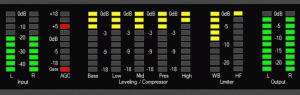
Link to Omnia processors and encoders.
Audio Processing




Audio Processors
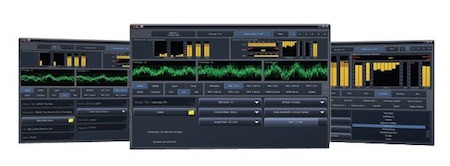
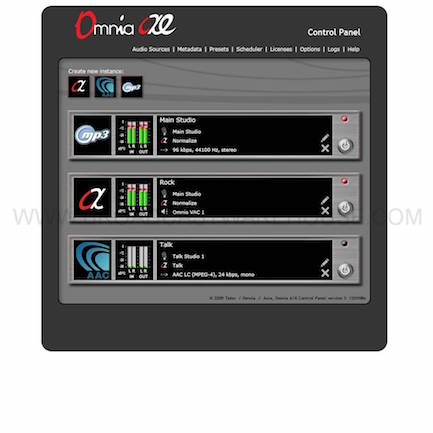
The Omnia A/XE Streaming Audio Processor will make a huge difference to the sound of your programme and make sure the audience's listening experience enhances their mood. It should keep them listening for longer and bring them back for more!
Omnia A/XE features adjustable wide-band AGC with a three-band compressor/limiter and a precision look-ahead final limiter to prevent clipping. Resulting streams are cleaner, clearer and with more audible presence.
Make your radio station's sound so pure, so clean and compelling listening that it's almost an unfair advantage! Omnia A/XE runs in the background as a Windows service. It can be fully-managed and configured remotely with a web browser, and can even process and encode multiple streams in various formats all at the same time.
Encode directly to MP3 or AAC, feed a Shoutcast-style or Windows Media Server in the MP3 format, or stream to Adobe Flash clients through a Wowza Media Server. You can also pair Omnia A/XE with your existing Windows Media, Real, mpgPRO or MP3 streaming encoder. The Omnia needs a Windows machine to run on and costs £269 and you can get them from Broadcast Warehouse.
dbx 286S
The DBX 286S is a very versatile microphone Pre-amp with compressor, de-esser, LF & HF Detail & expander and gate. It provides all the mic processing tools you need in one box including a full featured Channel Strip Processor that includes studio quality microphone preamplifier and four processors that can be used independently or in any combination.
The sonically pristine dbx 286s Mic Preamp has all the features you need, including wide-ranging input gain control, switchable +48V phantom power, and an 80Hz high-pass filter to remove low frequency hum, rumble or wind. These are artefacts that are best removed BEFORE your regular audio chain. It eliminates vocal sibilance too - Usually selling for £160, the dbx 286S is only £132 HERE.
see also the Microphone FX page