Laser shirts
now available
Laser Tee shirts and Polo shirts are now available. They have the 4 colour Laser 558 All Europe radio logo beautifully emboridered onto top quality black Tee shirts or Polo shirts. These are available in 8 sizes.
Full details on the LASER page
and ordering buttons
The beginnings of
Offshore Radio
Why offshore?
The reason is simply to circumvent the often restrictive licensing laws encountered in some countries, principally Europe, but often other countries too., In fact, the USA seems to have played host to the first offshore broadacsts.
A radio station on board a ship; it sounds an odd idea to say the least, especially one wildly rocking far out at sea! That might sound to the layman one of the strangest places on earth to broadcast from. Dangerously high voltages, seawater and ever-seasick disc jockeys all make for quite a potent mixture. So why broadcast radio programmes from a ship?
The reason goes back to the very dawn of broadcasting, in the 1920s. Governments all over the world were anxious to control this new media and they imposed tight rules on who could and who may not broadcast as well as the material that might be discussed on the air. The lightest regulatory touch was that of the FCC in the USA, but even they were quite strict about things like power levels, and programme material.
Government laws however only control what happens on their sovereign territory and in a narrow strip of sea along their coast. That strip of territorial waters was, for many years, three miles. The measure was chosen as it was about the distance a cannonball would travel, at the time when the first international agreements about 'territorial waters' were made, and it's been that way ever since. A few countries claim a wider strip as their own and those claims are generally respected, though not universally accepted.
In recent years UNCLOS (United Nations Convention on Law of the Sea) extended territorial waters to twelve miles, with a further area of up to 24 miles to protect some nations' areas of economic interest, a so-called 'contiguous zone'.
The two hundred miles limit brings a lot of countries into conflict and has not been 'tested', i.e. no country has tried to exercise its right to control ships, and especially not to board any for either checks or to impose its domestic laws, on ships so far from its coast.
Not all countries accept the UNCLOS regulations and several have so far refused to sign. Most European countries including the UK ratified the treaties eventually, but many countries do not accept the UNCLOS conventions, including Israel, Syria, Turkey and the United States.
Beyond International Waters
Out beyond the limits of territorial waters is an area that is not within anyone's territorial waters is known as 'the high seas' that by international agreement belongs to no one. These 'international waters' were agreed to enable the ships of all countries to pass unhindered between neighbouring states.
They are sacrosanct and well defined in international treaties. Fishing, oil exploration and travel are all vital to the integrity of 'international waters' and it is very rare for a country to interfere with the peaceful passage of another nation's ships, except in times of war. Indeed, the act of aggression on another nation's ships has often been an act of war and precipitated lengthy disputes.
High Power 'Border Blasters'
By the 1930s it became possible for radio stations to cover much greater distances thanks to newer high power transmitters. The American FCC put a cap on the power levels of stations, which encouraged local broadcasting, with a few large networks developing, such as NBC, CBS, Mutual, etc.
Those limits of power output did not apply over the border in Mexico and several entrepreneurs set up very powerful stations, with power levels up to 250,000 watts, five times what was permitted in the USA. These cross-border stations did good business running commercials for products that were banned from the airwaves in the USA, including several medical services of dubious efficacy, such as goat gland transplants for 'gentlemen of diminishing libido'.
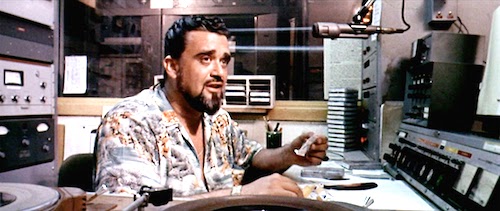
The bstory of some of these stations is on a page of its own BORDER BLASTERS. Read here how many DJs such as the legendary WOLFMAN JACK became natiuonally known for their broadcasters from 'across the border'.
The 'Bay Closing line' fiddle
The idea of extending territorial water by drawing a 'bay closing line' across wide inlets is an interesting one, used again in the UK in the sixties. The shoreline's low water mark (called the baseline, from which all territorial limits are measured) can be drawn across the mouth of indentations. Generally countries simply use a 24 miles long line, the maximum permissible under the UNCLOS treaties.
This practice was adopted by the UK in 1964 and it decided the selection of the anchorages chosen for many radio ships ever since. It was also a key tool used by the prosecution in cases against radio broadcasters using abandoned military structures out in the Thames estuary. Justifiable for security reasons, it has been exploited in various areas, such as by Libya at the end of the 20th Century when they applied it to the 'bay' of Benghazi. An international dispute over territorial waters between Malta, Libya and Tunisia had to be decided by the International Court of Justice in The Hague.
First widely heard European offshore station - the MV Courier (a US Coastguard vessel) which broadcast the Voice of America from the Mediterranean into Russia.
After World War II, the NATO countries wanted to spread the word of freedom behind the Iron Curtain that had descended across Europe. Much had been learned in the war years about the value of propaganda, especially by radio. Once the Cold War began in the early 1950s, the three main powers stepped up their international transmissions accordingly.
Some of the western broadcasters, such as the BBC World Service and the USA's Voice of America, could not be clearly heard in many parts of the USSR, so the American coastguard took a leaf from the mobsters' book and fitted out a ship called The Courier to beam its radio programmes into Russia. The best location for the ship was found to be at the eastern end of the Mediterranean Sea, from where the MV Courier beamed in its diet of news and comment.
The VoA ship had very powerful medium wave and short wave transmitters on board, over 150,000 watts, very high power levels for that period. Most of the programmes were originated at studios in the USA and sent to the MV Courier by short wave radio. Technicians on the ship recorded them and then they were rebroadcast by the on board MW and SW transmitters.
Several antennas were installed on the Courier, including a novel long wire antenna held up by a helium balloon floating several hundred feet above the deck. This was an excellent way to get the most efficient (electrically) aerial on a ship out at sea. The reason for this is that a medium wave antenna needs to be very long if it is to operate with reasonable efficiency. The operation was a great success and eventually, the Greek Government gave her a permanent base in Rhodes.
The Legendary
~ Radio Caroline
(Click ships to see more details)
Offshore Radio in the 1930s
During the years of prohibition, organised crime syndicates in the USA realised that operating on boats located just outside territorial waters was a great way to get round many laws, particularly the lucrative vices of gambling and drinking. Offshore casinos with licensed bars popped up off California and to promote their services they established radio stations on board.
Among the biggest of the ships were the City of Panama, which broadcast its own station on 815kHz AM, and a ship called Rex. They were run by mobster Tony Cornero and financed by Bugsy Siegal, a legendary underworld figure at the time. They spent over $1m US to equip and float their ships, whose radio signals could be heard all along the western seaboard of the USA, attracting business to the ship. With a staff of 300 it could hold over 2000 customers, so clearly the offshore gambling boats were a big business. Without the radio stations on board them, it's doubtful they could have attracted enough business.
Pirate Memories
Pirate Memories was created in 1999 to bring to the publics attention, a film that was originally shot in 1966. The film was taken on the 60’s pirate radio ship 'The Galaxy', and featured daily life on board 'Radio London'.
The film had at some stage, been transferred to a VHS video tape, and was found along with other pirate radio recordings & memorabilia in a suitcase that had been left after its owner emigrated to Australia in the late 80’s. The owner of the film has never been traced. (was it YOU? if so, please contact Chris at Pirate Memories)
The Radio London film shows the everyday routine on board the radio ship Galaxy, with tenders arriving and departing, shots of the studio, with DJ’s on air, and exteriors of the ship during the many weather conditions the ship had to endure during its two and a half years at sea between December 1964 and August 1967.
The film was digitally cleaned, and an authentic 60's soundtrack was added, along with a five minute film dedicated to Radio London, which was produced just as the station closed in August 1967.
Many copies of the film have been sold around the world, and now Pirate Memories have copies for sale in their shop. You can also see fabulous displays of Pirate Radio recordings and memorabilia, from those halcyon days of offshore radio broadcasting.
Pirate Memories has souvenirs from all of the 60’s offshore pirate stations, Radio Caroline, Radio London, Radio 270, Radio England and dozens more! They also have even more of the 1970’s and 1980’s pirate stations too.
Pirate Memories has also supplied and helped a number of production companies and media students with audio and photographic material for their programmes and degree research and thesis.
More books about the World of Radio
There are thousands of
books about radio and we have reviewed some of those books that we believe may be of interest to you. There are currently over 300 radio books in our library which we shall review over the next few weeks, so do visit our BOOKS section often.
Almost every Government in Europe kept very tight state control over broadcasting; Some entrepreneurs thought the Voice of America ship in the Mediterranean was a good template for setting up stations in Northern Europe and by 1958 the first stations were heard in Scandinavia. They were a success, and Radio Mercur was swiftly followed by Radio Syd, Radio Nord and many others.
Word of this method of getting around the broadcasting legislation, by going offshore, spread to the UK, with the first radio ship off England being Radio Caroline in 1964. In the mid 1960s over a dozen stations beamed the latest music into the UK from ships.
Most stations were starved out by new laws in August 1967 which made it an offence for British ships to be used for broadcasting or supplied to come from the UK.
Radio Caroline continued, obtaining supplies from Holland, which had no such laws until 1974. Radio Caroline again continued once again with the ship supplied from Spain and other countries.
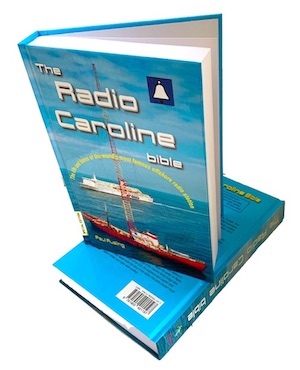
THE RADIO CAROLINE BIBLE
is a fascinating new book that tells tells the inside story of Radio Caroline, from the very beginning of the project – right up to date.
It’s packed with 'stories from the inside' about the many disasters, boardings, excitement and copious amounts of skull-duggery. There are many inside tales about the major events from all of Caroline’s four eras, told by many of the key people who made Radio Caroline happen. It has a lot of unique content & ‘never published before’ photographs.
Chronologically correct, the Radio Carolione Bible is illustrated with over 300 photos and drawings. Casebound with strong covers in full colour, the Radio Caroline Bible has over 500 pages. A gorgeous book that will last for many years. It's a limited print run will surely become a collector’s item.
CLICK for details, reviews & sample.
THE RADIO CAROLINE BIBLE
. . is a fascinating new book that tells tells the inside story of Radio Caroline, from the very beginning of the project – right up to date.
It’s packed with 'stories from the inside' about the many disasters, boardings, excitement and copious amounts of skull-duggery. There are many inside tales about the major events from all of Caroline’s four eras, told by many of the key people who made Radio Caroline happen. It has a lot of unique content & ‘never published before’ photographs.
The updated edition of the Radio Caroline Bible is illustrated with over 300 photos and drawings. Casebound with strong covers in full colour, the Radio Caroline Bible has 558 pages. A gorgeous book that will last for many years. It's a limited print run will surely become a collector’s item.
CLICK for details, reviews & sample.
Pirate Memories
Pirate Memories was created in 1999 to bring to the publics attention, a film that was originally shot in 1966. The film was taken on the 60’s pirate radio ship 'The Galaxy', and featured daily life on board 'Radio London'.
The film had at some stage, been transferred to a VHS video tape, and was found along with other pirate radio recordings & memorabilia in a suitcase that had been left after its owner emigrated to Australia in the late 80’s. The owner of the film has never been traced. (was it YOU? if so, please contact Chris at
Pirate Memories)
The Radio London film shows the everyday routine on board the radio ship Galaxy, with tenders arriving and departing, shots of the studio, with DJ’s on air, and exteriors of the ship during the many weather conditions the ship had to endure during its two and a half years at sea between December 1964 and August 1967.
The film was digitally cleaned, and an authentic 60's soundtrack was added, along with a five minute film dedicated to Radio London, which was produced just as the station closed in August 1967.
Many copies of the film have been sold around the world, and now Pirate Memories have copies for sale in their shop. You can also see fabulous displays of Pirate Radio recordings and memorabilia, from those halcyon days of offshore radio broadcasting.
Pirate Memories has souvenirs from all of the 60’s offshore pirate stations, Radio Caroline, Radio London, Radio 270, Radio England and dozens more! They also have even more of the 1970’s and 1980’s pirate stations too.
Pirate Memories has also supplied and helped a number of production companies and media students with audio and photographic material for their programmes and degree research and thesis.
'Bay Closing line' fiddle
The idea of extending territorial water by drawing a 'bay closing line' across wide inlets is an interesting one, used again in the UK in the sixties. The shoreline's low water mark (called the baseline, from which all territorial limits are measured) can be drawn across the mouth of an indentation, where the volume of water within the artificial line is greater than that covered by a semicircle drawn with the line as its diameter. Generally countries simply use a 24 miles long line as the baseline, the maximum permissible under the UNCLOS treaties.
This practice was adopted by the UK in 1964 and it decided the selection of the anchorages chosen for many radio ships ever since. It was also a key tool used by the prosecution in cases against radio broadcasters using abandoned military structures out in the Thames estuary. Justifiable for security reasons, it has been exploited in various areas, such as by Libya at the end of the 20th Century when they applied it to the 'bay' of Benghazi. An international dispute over territorial waters between Malta, Libya and Tunisia had to be decided by the International Court of Justice in The Hague.
Remember Summer 1987 ?
with the fab aerial shot of Caroline's Ross Revenge at the South Falls Head.
A3 size poster now for sale, £3.90
RADIO SEAGULL was another radio station which broadcast from the Caroline ship, the Mi Amigo, in 1973 and 1974. It returned to the air in 2003 broadcasting from a converted lightship in and close to the Dutch port of Harlingen.
Almost every Government in Europe kept very tight state control over broadcasting; almost all the private stations that had been tolerated in the 1930s in some countries, were frozen out after WWII. Some entrepreneurs thought the Voice of America ship in the Mediterranean was a good template for setting up stations in Northern Europe and by 1958 the first stations were heard in Scandinavia. They were a success, and Radio Mercur was swiftly followed by Radio Syd, Radio Nord and many others.
Word of this method of getting around the broadcasting legislation, by going offshore, spread to Holland and Belgium and then eventually the UK, with the first radio ship off England being Radio Caroline in 1964.
Radio Caroline arrived just in time to help boost the burgeoning British music explosion, spear-headed by the Beatles and the Stones. In the mid 60s over a dozen stations were beaming the latest music into the UK from a variety of ships and old forts.
Most of the radio ships were starved out by new legislation in August 1967 by the Marine Offences Act, which made it an offence to use a British ship for broadcasting in British waters, to supply anything for use in offshore radio. For the first time it became illegal to play a pop record, read the news or preach a sermon on the radio, if it was transmitted by a ship.
Radio Caroline bravely continued, obtaining the ship's supplies from Holland, which had no such laws until 1974. In that year, the Dutch brought in similar legislation and three of the four radio ships moored off its coast, Radio Veronica, Radio Atlantis and Radio North Sea International, all closed down.
Caroline continued again, ostensibly supplied from Spain, although much closer ports were used covertly to keep the stations on the air in lcuding Radio Mi Amigo, and later Radio Monique - which both broadcast in Dutch and Flemish.
Radio Caroline is a privately owned radio station, that launched in 1964 and now in its sixth decade of operations.
It has used five ships but nopw has only one remaining, the former Grimsby trawler the Ross Revenge. The ship is no longer out at sea, but is moored in the River Blackwater in Essex, from where some programmes are made.
Many of Caroline's programmes are made by vthe DJs at home and at their studio centre in Strood, Kent.
For more dtails on Caroline, click the radio ships.
A real collectors item, Hans Knot's 'All Europe Radio - Laser558 ' book tells all about Laser's star DJs such as Jessie Brandon, Dave Lee Stone, Tommy Rivers and the one and only Seawolf, as well as the commercials heard on the station & the plug records. Its back on sale again from World of Radio. Click the cover for details.