Radio Veronica


Radio Veronica DJ Rob Out
Veronica studio delivery
Tapes delivered into the studio
on board the Radio Veronica ship
Norderney at sea in 1971
Radio Veronica on full power
Radio Veronica girl invites you to go with her to 538 Metres in 1972
Click for information button
The new Laser Radio Programming book has 175 pages describing radio programming policy and techniques of the major offshore stations, but especially Radio Caroline, Laser and the Laser project's 'grandad' whose style and fresh format inspired the founders, 1966 super station  - Swinging Radio England.
 
There's a reprint of Laser's full Operations Manual and a discussion on the format, music playlisting, strap lines, trailer production and other techniques that Laser used to attract an audience of ten million listeners in the UK & Benelux.
  
The book also looks at how the Laser name, imaging and ethos has been used  to change radio since. There are details of radio ships YOU can visit; not one, not two but THREE radio ships! The book lists all the Laser DJs -  their biographies & pictures too!
 
LASER helped revolutionise British radio. Its effects are still felt today and more Laser ideas may be put into action soon, as rules on radio are further relaxed. 
 
Laser Radio pogramming book cover
Radio Adventures Communicator cover
Radio Adventures of the Communicator is one of the most action packed stories of offshore radio, told by those who were there!
 
It's a story with gangsters, crooks and fraudsters, a Government blockade on supplies, the dramas, an armed raid, 'middle of the night" boardings, take-overs and more. the heroes are the gallant crew of DJs and brave bunch of engineers who kept the music and entertainment flowing against all odds while a few landlubbers coined in literally millions or pounds and guilders. The ship was home for the launch of VERONICA HOT HITS, anchored on the IJsselmeer.
 
Told by some of the best known names in British and Dutch radio and put into context by Paul Rusling, who advised many of the stations. This was real life adventure on the High Seas; many of the full stories about these events are being told in print for the first time.
 
Internet Radio 2016, or How to Launch and Operate your own Station, (web, online, internet or streaming) is the almost up-to-date guide to these exciting new media opportunities. 
 
This is  a fully comprehensive guide that considers the latest radio scene and how radio transmission has divided into two very different routes. Direct 'over-the-air' and internet streaming. Internet Radio is available as a 'hard-copy', printed book, or as an E-Book that can be read on Kindles, iPads or mobile phones.
   Internet Radio  
Launch & operate your own station
 
Internet Radio 2016 book cover
 
Internet Radio 2016
 Is available as an e-Book
or a printed 276 page book
Click HERE for details
 
 
Two great books about
LASER
One of the most exciting
radio ventures ever!
 
MI AMIGO 45: HAVENFEESTEN Blankenberge
Thursday 30 May  to 2 June 2019
The Mi Amigo40 ship being used in 2019 is the Castor,  an identical sister ship of Radio Caroline's Ross Revenge tender,  'Bellatrix' and of the Greenpeace ship the 'Sirius'.
 
The Bellatrix tendered the Ross Revenge in the 19890s when Radio Caroline and Radio Monique were broadcasting from her.  
 
The Sirius also tendered Radio Caroline in the 1980s in exchange for commercials for Greenpeace.
 
The Castor also supplied the Ross Revenge sometimes, when the Bellatrix was unable to sail. The Castor is one of seven sister ships built in the 1950s in Rotterdam for the Dutch Navy. They all carry the name of stars - so essential to sailors for  celestial navigation .  Today, most use the GPS system, but real; sailors keep their celstial naviagtion skills up to date, just in case the satellites fail!
 
The seven star sister ships were:  Antares, Castor, Bellatrix, Betelgeuse, Pollux, Procyon & Sirius. "
 
 
Radio Mi Amigo Memories
Even though Offshore radio has left the North Sea many stations still exist on land and are very popular.  There are two other organisations using the Radio Mi Amigo banner - one is Radio Mi Amigo International, a short wave station broadfcasting on high power from Germany, and the other is a group of fans who broadcast in Harwich from the LV18 (an old lighthship) for a week every Summer.
 
 
Belgium and Offshore Radio
While Belgium had some of the world's first broadcasts (as early as 1910, thanks to the Belgian Royal family being very interested), its broadcasting was government controlled.   In 1962, Radio Antwerpen  began transmission from a ship moored off Ostend, the MV Uilenspiegel.  The owner, George fell ill and a few days later the ship ran aground on the beach at Knokke, on the border with Holland.  It remained entrenched in the sand for the next 15 years.
 
In Summer 1973, Radio Atlantis began broadcasting to Belgium, initially from the Mi Amigo, then anchored off Scheveningen, and later with its own ship, the MV Jeanine.  It had a Flemish service during the day and  English programmes at night.  Radio Atlantis closed down when the Dutch anti-radio ship law took effect, at the end of August 1974.
 
Radio Mi Amigo launched its programmes on New Years Day, 1974, broadcasting  from the Radio Caroline ship the Mi Amigo, from where the station took its name.  It continued until 1978, when the crew left the Mi Amigo for their own vessel, the MV Magdalena, anchored closer to Belgium.
 
The new Radio Mi Amigo ship had been fitted out in Greece by tender operator Patrick Vallain, although it took them a long time to get it operational. radio Mi Amigo transmissions were made using a 10kW transmitter on 272 Metres, but after only a few months the ship lost her anchor and was arrested by the Dutch in September 1979.
 
Radio Caroline continued with Flemish and Duitch programmes for another year but that service closed in March 1980 when the Mi Amigo ship foudnered.

When Radio Caroline returned from a new ship, the Ross Revenge, Dutch programmes commenced once again as Radio Monique (after Fred Bolland's wife).  Tenders for the Radio Caroline ship were operated from several Belgian and French ports.
 
In 1989 another radio ship moored off Zeebrugge; the MV Nannell broadcast for a very short time on FM but returned to the UK shortly afterwards.
Internet Radio 2016, or How to Launch and Operate your own Station, (web, online, internet or streaming) is the lmost up-to-date guide to exciting new media opportunities. 
 
This is  a fully comprehensive guide that considers the very latest radio scene, how radio transmission has divided into two very different routes. And its now available as a hard copy book, or as an E-Book.

Veronica Norderney ship colour
Radio Veronica broadcast from the MV Norderney anchored off Scheveningen until September 1974. It replaced the old Borkum Riff lightship in November 1964
 
The ship stayed at sea for a year after the Dutch anti-radio ship law came in, but eventually came inshore. It has since been moored in several towns in Holland and Belgium, and was operated as a nightclub and bar. 
 
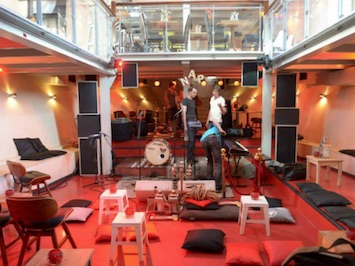
Six years ago the ship came to Amsterdam and has since been tied up at the NDSM wharf, next to the HotelBoot. It has been open from time to time and operated as a bar and cafe. 
 
 
Veronica 538 Girl
radio Veronica ship at the NDSM in Amsterdam
Radio Veronica ship restaurant
In the early 1980s the former Radio Veronica ship was bought by a Friesland entrepreneur and towed from her berth in Dordrecht, up to the north of the Netherlands. She served as a nightclub and bar for several years in Gronigen before being moved to Antwerp.
 
Eventually a berth was found for the Norderney in the centre of Amsterdam at the former NDSM wharf, which is undergoing development as a major tourist, office and residential centre.  Business was good after launch - the ship had excellent transport links with a free ferry service every 20 minutes across to the Centraal station in Amsterdam.


After the Dutch anti radio-ship law took effect in 1974, Radio Veronica increased its efforts to become a public company and opened its membership up to everyone. Very soon they had well over a million 'shareholders'.  The body the Dutch listeners joined was the VOO - Veronica Omroep Organisatie (the Veronic Broadcasting Organisation).
 
As with most things connected with Radio Veronica, the VOO was indeed very well organised, led by one of Radio Veronica's best known and most loved djs, ROB OUT. 
 
With the increase in size of the VOO, it qualified for broadcast time on the Dutch public radio system.  Air time was given to the VOO on each of the national networks (there were four at the time) and later the VOO was allowed onto TV.
 
VOO goes private
 
By the 1990s, the Nethlands still permitted only the state 'public' radio and TV system to broadcast programmes 'via the ether'. 
 
Some former Radio Veronica and Radio Caroline staff began broadcasting via satellite from the UK. These programmes were then picked up by cable operators and fed into homes on FM, meaning that some stations (initially just Cable One, but later Sky Radio, Radio 538, RTL, etc) could begin building big audiences. 
 
The protection of state broadcasters from competition was pronounced illegal, so some frequencies were offered for private radio.
 
 
Veronica in the 2020s
Today,  Radio Veronica is part of the Talpa Media Group./ The station is aimed at middle-aged men and now attracts over one million listeners every week. 
 
Talpa's other three radio stations are Radio 10, Sky Radio and Radio 538, all founded by former Radio Caroline and Radio Veronica DJs (Jeroen Soer, Ton Lathouwers and Lex Harding). Those three stations are now numbers 2,3 and 4 for Dutch radio listeners, attracting over 9 million listeners a week.     (Latest NRO numbers here)
 
In Netherlands, only 13.2 m people listen to the radio, so those three Talpa stations 'born from offshore radio' are now winning over 70% of radio listeners!
When the new private licences were offered in 1993, there were 28 applications for only 5 national networks. The two FM networks were given to RNN (playing Dutch language pop) and Classic FM from England. MW channels were given to Radio 10, Holland FM (on AM!) and Elle Magazine. 
 
The VOO decided to break away from the public system and become a private organisation; it bought up Holland FM and, using a 60KW transmitter on the former Laser ship, the MV Communicator, launched as Veronica Hit Radio. It was a huge success. (Full story in the book Radio Adventures of the MV Communicator).
 
Veronica seized the opportunity to move to FM in 1999 and has since become a part of TALPA, a huge multi- media organisation set up by Jon de Mol, who operated Radio Noordzee at sea until 1974.
Radio Veronica ship
Norderney berthed inland

Radio Veronica on shore
Radio Veronica ship in colour
Copyright (c)  2011 - 2023 World of Radio Ltd, Registered in England and Wales # 8503418. 
All Rights Reserved. 
Reproduction strictly prohibited.