LEGALITY
It is still possible to broadcast radio & TV programmes from a ship but professional help is recommended in order to to avoid legal problems and technical difficulties.
Huge audiences can still to be reached in many parts of the world. We have the team and knowledge to achieve the coverage you want.
Seriously intending and financially qualified operators can contact (WBC) at this email address for help.


The beginnings of
Offshore Radio
Why offshore radio?
The reason is simply to circumvent the often restrictive licensing laws encountered in some countries, principally Europe, but often other countries too. In fact, the USA seems to have played host to the first offshore broadcasts.
A radio station on board a ship; it sounds an odd idea to say the least, especially one wildly rocking far out at sea! That might sound to the layman one of the strangest places on earth to broadcast from. Dangerously high voltages, seawater and ever-seasick disc jockeys all make for quite a potent mixture. So why broadcast radio programmes from a ship?
The reason goes back to the very dawn of broadcasting, in the 1920s. Governments all over the world were anxious to control this new media and they imposed tight rules on who could and who may not broadcast as well as the material that might be discussed on the air. The lightest regulatory touch was that of the FCC in the USA, but even they were quite strict about things like power levels, and programme material.
Government laws however only control what happens on their sovereign territory and in a narrow strip of sea along their coast. That strip of territorial waters was, for many years, three miles. The measure was chosen as it was about the distance a cannonball would travel, at the time when the first international agreements about 'territorial waters' were made, and it's been that way ever since. A few countries claim a wider strip as their own and those claims are generally respected, though not universally accepted.
In recent years UNCLOS (United Nations Convention on Law of the Sea) extended territorial waters to twelve miles, with a further area of up to 24 miles to protect some nations' areas of economic interest, a so-called 'contiguous zone'.
The two hundred miles limit brings a lot of countries into conflict and has not been 'tested', i.e. no country has tried to exercise its right to control ships, and especially not to board any for either checks or to impose its domestic laws, on ships so far from its coast.
European Governments kept tight control over broadcasting after WWII. Some entrepreneurs thought the Voice of America ship in the Mediterranean was a good template for setting up stations in Northern Europe and by 1958 the first stations were heard in Scandinavia. They were a success, and Radio Mercur was swiftly followed by Radio Syd, Radio Nord and many others.
Word of this method of getting around the broadcasting legislation, by going offshore, spread to Holland and Belgium and then eventually the UK, with the first radio ship off England being Radio Caroline in 1964. She arrived just in time to help boost the British music explosion, spearheaded by the Beatles and the Rolling Stones. In the mid 1960s over a dozen stations were beaming the latest music into the UK from a variety of ships and former defensive forts.
Most of the stations were starved out by new legislation in August 1967 by the Marine Offences Act, which made it an offence to use a British ship for broadcasting in British waters, to supply anything for use in offshore radio. For the first time it became illegal to play a pop record, read the news or preach a sermon on the radio, if it was transmitted by a ship at sea.
Radio Caroline bravely continued, obtaining the ship's supplies from Holland, which had no such laws until 1974. In that year, the Dutch brought in similar legislation and three of the four radio ships moored off its coast, Radio Veronica, Radio Atlantis and Radio North Sea International, all closed down.
Radio Caroline again continued and moved its remaining ship, the MV Mi Amigo, to a convenient anchorage just off the Thames estuary.


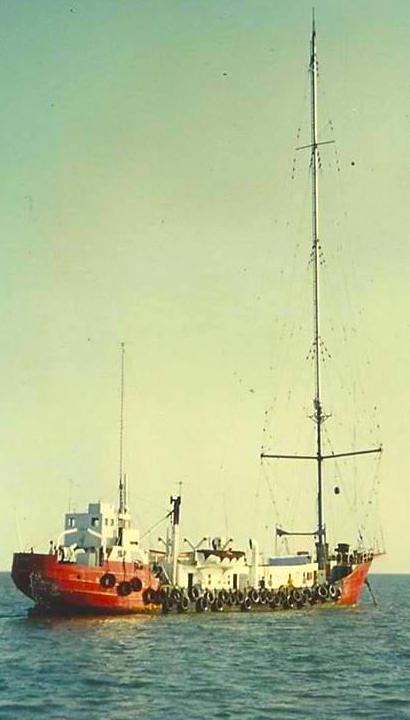
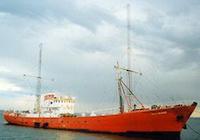
Two of Radio Caroline's first ships - the Fredericia (above in Ramsey Bay) and the Mi Amigo (below) off Frinton, Essex)



Now available
in printed form
(a real book ! )
Ideal for your any
radio afficionado's shelf
Just £19.95
FREE P&P
Full details telling you what you need, how to assemble everything, how much should you pay and how to launch. Where do you get the bandwidth to broadcast, which system should you use and how do you promote your station?
To get this information on a seminar or course would cost about $1,500. Download it today, onto your computer, tablet or any iPhone and read all 77,000 words straight away.

Ever wanted your very own
ONLINE RADIO STATION ?

Only $9.99 / £6.68
Few seriously complained about Radio Caroline and so little enforcement action was taken against her. Eventually in March 1980 the ship ran aground on a sandbank in the Thames estuary, and was lost. Radio Caroline family promised to return, but few thought the station would ever reappear. But reappear she certainly did; bigger and better than ever.
In the 1980s no less than four radio ships appeared in the North Sea, with Radio Caroline returning with a huge converted former Icelandic trawler, the MV Ross Revenge.

LEGALITY
It is still possible to broadcast radio (and even TV) programmes from a ship but professional help is recommended, in order to avoid legal problems and technical difficulties.
Huge audiences can still to be reached in many places and if the cost is worrying you, well it's not necessary to be a lottery winner to accomplish it; but you cannot achieve much on pocket money!
Seriously intending and financially qualified operators are advised to contact WBC at this email address for help and assistance.



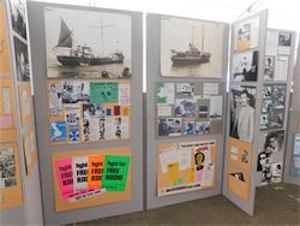
The well-loved Offshore Radio exhibition continues its UK tour with several dates.
The exhibition is run by Chris Dannatt of Pirate Radio Memories of Lincolnshire whose web site has the latest tour info'. Allow at least an hour to peruse the exhibits which include many rare and long-hidden artefacts from the golden years of Offshore Radio.
Pirate Memories
Chris Day's Pirate Gold
can now be heard on RTI
Saturday afternoon from 14.00 - 16.00 UK time
if your are on continental time then its 13.00 to 1500 CET
Two solid hours of pure pirate nostalgia with off-air recordings of all the offshore stations, plus, original tunes and interviews with many of the DJs and staff involved.
Join us each week on RTI
(the Station of the Stars)
Pirate Memories
Pirate Memories was created in 1999 to bring to the public's attention, a film that was originally shot in 1966. The film was taken on the 60’s pirate radio ship 'The Galaxy', and featured daily life on board 'Radio London'.
At some stage the film had been transferred to a VHS video tape, and was found along with other pirate radio recordings & memorabilia in a suitcase that had been left after its owner emigrated to Australia in the late 80’s. The owner of the film has never been traced.
The Radio London film shows the everyday routine on board the radio ship Galaxy, with tenders arriving and departing, shots of the studio, with DJ’s on air, and exteriors of the ship during the many weather conditions the ship had to endure during its two and a half years at sea between December 1964 and August 1967.
Many copies of the film have been sold around the world, and now Pirate Memories have copies for sale in their shop. You can also see fabulous displays of Pirate Radio recordings and memorabilia, from those halcyon days of offshore radio broadcasting.
Pirate Memories has souvenirs from all of the 60’s offshore pirate stations, Radio Caroline, Radio London, Radio 270, Radio England and dozens more! They also have even more of the 1970’s and 1980’s pirate stations too.
Pirate Memories has also supplied and helped a number of production companies and media students with audio and photographic material for their programmes and degree research and thesis.
Email Chris at piratememories266@gmail.com



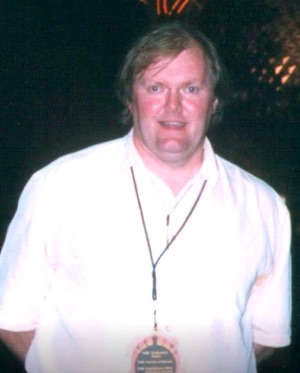

Pirate Memories boss Chris Dannatt

More books about the World of Radio
There are thousands of books about radio and we have reviewed some of those books that we believe may be of interest to you. There are currently over 300 radio books in our library which we shall review over the next few weeks, so do visit our BOOKS section often.
More books about the
World of Radio
There are thousands of books about radio and we have reviewed some of those books that we believe may be of interest to you. There are currently over 300 radio books in our library which we shall review over the next few weeks, so do visit our BOOKS section often.

Chris Dannat of Pirate Radio Memories with an original Radio Caroline sales chart showing prices of the 1965 advertising time on the two ships.
Roberts R9993
3-Band Portable Radio

3 band portable radio
LW/MW/FM wavebands
Large Dial tuning mechanism
LED power indicator
Headphone socket & DC input
Angled top panel for ease of use
Pirate Radio Memories
Legendary Radio Caroline
Copyright (c) 2011 - 2023
World of Radio Ltd
Registered in England and Wales # 8503418.
Reproduction strictly prohibited.
All Rights Reserved.